Granite Base Supplier
for CMM & Machine Tools
Get matched with verified granite base suppliers by load, size, hole pattern and flatness. For CMMs, semiconductor tools, machine beds and precision instruments.
Matching advice within 1 business day · No upfront matching fee
Submit Your Granite Base Requirements
No complete drawing needed. Leave your contact details and a brief description. We'll get back to you within one business day.
What Is a Granite Base?
A granite base is a load-bearing foundation under precision equipment. It absorbs vibration, maintains geometry and provides mounting points for the machine structure.
- Load support & damping High-density granite reduces micro-vibration during measurement or machining, improving repeatability and surface quality.
- Common applications CMM foundations, semiconductor inspection tool bases, machine tool beds, precision instrument mounts and optical table supports.
- Highly customizable Bases usually need mounting holes, T-slots, threaded inserts, guide-rail surfaces and other features, making them more complex than flat plates.
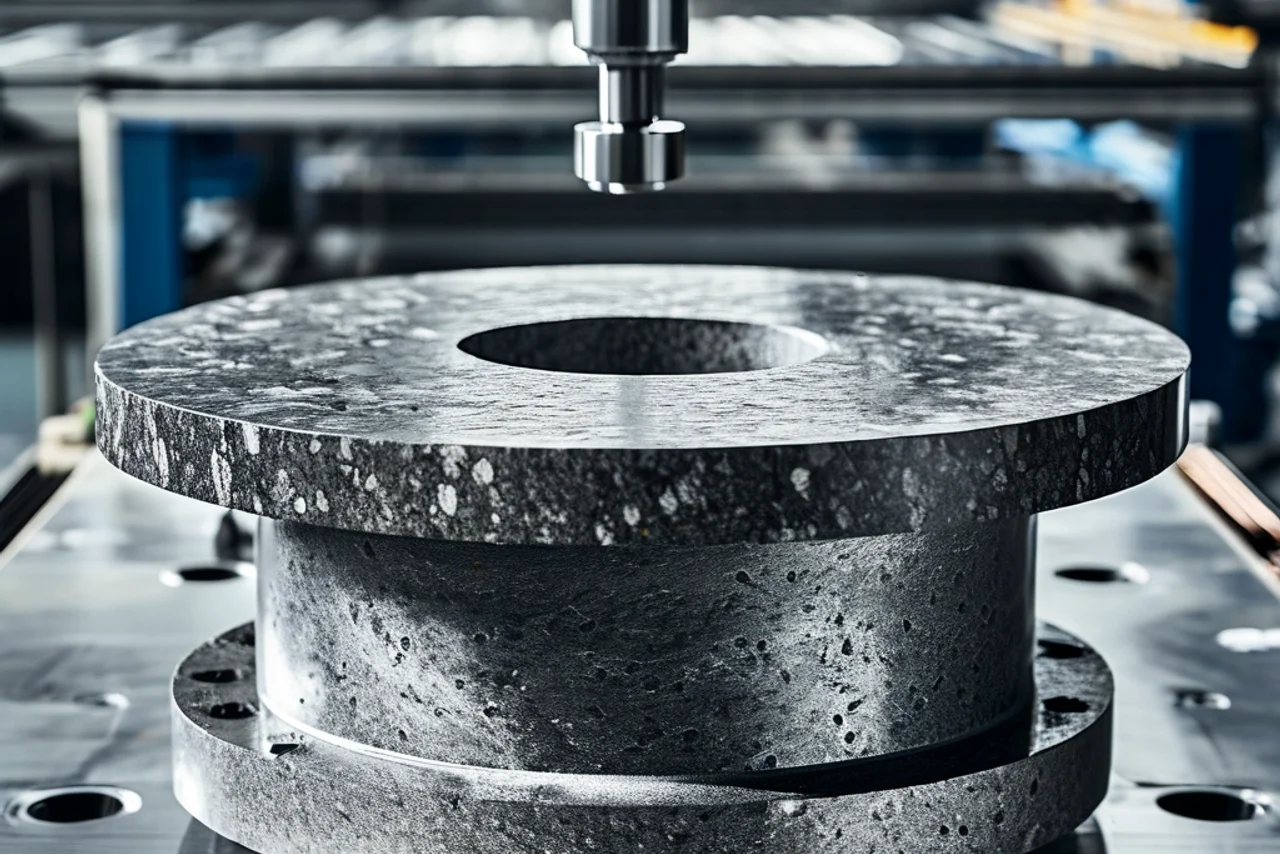
Common Specifications & Tolerances
Granite bases vary widely in size and feature complexity. Large sizes and detailed hole patterns drive supplier selection.
How to Evaluate a Granite Base Supplier
Base machining is about more than flatness. Size capacity, hole-pattern accuracy and assembly support are just as important.
Large-Format Capacity
Can they machine single-piece bases above 3000 mm? Do they have cranes, floor load capacity and transport logistics?
Hole Pattern Accuracy
Threaded inserts, dowel holes and rail surfaces must be positioned accurately relative to the reference plane.
Assembly & Inspection Support
Can they simulate assembly, run CMM checks and deliver full-dimension reports?
Material & Stability
Are they using stable black granite grades? Has the material been properly aged before finish machining?
Lead Time & Capacity
Large bases take longer. Confirm current shop load, production schedule and buffer for rework.
Batch Consistency
For long-term production programs, hole positions and flatness must stay consistent from unit to unit.
Typical Granite Base Machining Challenges
Bases are more complex than flat plates. These are the issues that separate capable suppliers from the rest.
Flatness Over Large Areas
Large bases are more sensitive to uneven lapping pressure and temperature gradients during machining.
Hole Pattern Positioning
Multiple mounting features must maintain tight relative position, perpendicularity and coaxiality.
Transport & Installation Distortion
Large bases can move during lifting, shipping and bolting down. Proper support and packaging are essential.
Stress Relief & Aging
Without sufficient aging after rough machining, the base can change size during finishing or in service.
Match Granite Base Suppliers by Load and Hole Pattern
Based on base size, hole complexity, guide-rail mounting requirements and equipment type, we identify verified suppliers capable of large-size machining, hole systems and assembly inspection.
Ready to recommend to end customers. Full capability for large sizes, complex holes and complete inspection.
Good fit for general precision bases and batch work with solid value.
Suitable for rough machining, pre-processing or suppliers being upgraded.
We do not promise "the best supplier." We match the supplier best suited to your current load, hole complexity and batch requirements.
When Buyers Come to AccuStone
These are common situations where the right granite base supplier makes the difference.
New Machine Development
You need 1–2 prototype bases with complex holes, fast response and tight tolerances.
Large Equipment Base Delivery
Single-piece size exceeds 3000 mm. You need to evaluate machining, transport and on-site installation.
Long-Term Production Program
You need stable delivery of bases for a product line. Consistency and supplier capacity are the priorities.
Granite Base FAQ
Questions buyers often ask before sourcing a granite base.
How large can a granite base be?
Common sizes range from 800×600 mm to 5000×3000 mm and larger. Oversize bases can be machined as one piece or built from precision-sectioned segments, depending on supplier capability.
How are threaded inserts and T-slots machined?
CNC drilling and milling create locating holes, dowel holes and insert pockets. Position accuracy, perpendicularity and repeatability relative to the reference surface are the key checks.
Why do semiconductor tools use granite bases?
Granite offers high density, low thermal expansion, good vibration damping and no magnetism. These properties reduce motion errors and improve measurement repeatability.
Is sectioned base assembly reliable?
Yes, when done by experienced suppliers. Segments are machined separately and then joined with precision alignment to maintain overall flatness and hole-pattern accuracy.
Should I choose a one-piece or sectioned base?
One-piece bases offer better stiffness and consistency for sizes that allow it. Sectioned bases suit oversize dimensions or transport constraints; the key is the supplier's splicing accuracy and on-site assembly capability.
What should a full-dimension inspection report include?
It should cover reference-surface flatness, mounting-surface parallelism and perpendicularity, hole-pattern position, insert quality, material identification and inspection conditions. Complex bases benefit from a full CMM report.
Need a Granite Base?
Tell us the size, hole pattern, grade and application. We'll match you with granite base suppliers that have the right equipment and experience.
Matching advice within 1 business day · Drawing info confidential